不 (bù)
不 (bù) is a general negation word used to express a simple “no” or “not.” When first learning Chinese you will use it often:
General Refusal:
A: 你想去吗?
Nǐ xiǎng qù ma?
Do you want to go?
B: 不,我不想去。
Bù, wǒ bù xiǎng qù.
No, I don’t want to go.
Negating Adjectives:
这个不贵。
Zhège bù guì.
This is not expensive.
Future Actions:
我不会做。
Wǒ bù huì zuò.
I won’t do it.
不 + [ ] (bù + [ ])
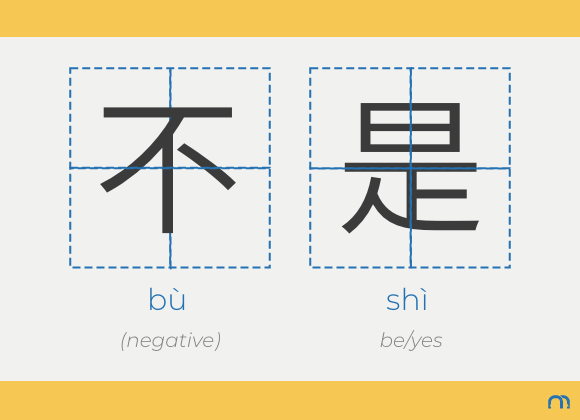
不是 (bù shì) • is not
Denying Statements:
When you need to correct or disagree with, 不是 (bù shì) is used to negate what has been said.
A: 你是老师。
Nǐ shì lǎoshī.
You are a teacher.
B: 不是,我不是老师。
Bù shì, wǒ bù shì lǎoshī.
No, I’m not a teacher.
不可以 (bù kěyǐ) • can not
Expressing Prohibition:
不可以 (bù kěyǐ) is commonly used to indicate that something is not allowed or is prohibited. This usage is suitable for both formal and informal contexts.
这里不可以吸烟。
Zhè lǐ bù kěyǐ xīyān.
Smoking is not allowed here.
不用 (bù yòng) • need not
Indicating No Need:
不用 (bù yòng) is often used to tell someone that something is not necessary or to decline an offer politely. This usage is common in both formal and informal settings.
A: 我帮你拿包吧。
Wǒ bāng nǐ ná bāo ba.
Let me help you carry the bag.
B: 不用,我自己可以。
Bù yòng, wǒ zìjǐ kěyǐ.
No need, I can manage myself.
没 (méi)
没 (méi), on the other hand, is used to express the negation of past actions and sometimes to indicate the absence of something.
Negating Past Actions:
A: 你吃饭了吗?
Nǐ chīfàn le ma?
Did you eat?
B: 没,我没吃。
Méi, wǒ méi chī.
No, I didn’t eat.
Indicating Absence:
我没钱。
Wǒ méi qián.
I don’t have money.
Expressing Non-Existence:
他没来。
Tā méi lái.
He didn’t come.
没关系 (méi guānxi) • It doesn’t matter/no worries
In Chinese, 没关系 (méi guānxi) is a versatile phrase that means “it’s okay,” “no problem,” or “don’t worry about it.” It is commonly used to reassure someone, respond to an apology, or indicate that a minor issue is not a big deal. Understanding how to use 没关系 (méi guānxi) appropriately will help you navigate social interactions and communicate effectively in various situations.
Responding to Apologies and Reassuring Others
When someone apologizes for a mistake or inconvenience, you can use 没关系 (méi guānxi) to tell them that it’s ok.
A: 对不起,我迟到了。
Duìbùqǐ, wǒ chídào le.
I’m sorry, I’m late.
B: 没关系,我们刚开始。
Méi guānxi, wǒmen gāng kāishǐ.
It’s okay, we just started.
没有 (méi yǒu) • don’t have
In Chinese, 没有 (méi yǒu) is a commonly used phrase that means “don’t have” or “there is not.” It is an essential part of everyday conversation, helping to express the absence or lack of something. Understanding how to use 没有 (méi yǒu) correctly will enhance your ability to communicate effectively in various contexts.
A: 你有笔吗?
Nǐ yǒu bǐ ma?
Do you have a pen?
B: 我没有笔。
Wǒ méi yǒu bǐ.
I don’t have a pen.
If you enjoyed this article, “No in Chinese” you may also enjoy learning about the difference between “The Difference Between Chinese and Mandarin“!

Leave a Reply
You must be logged in to post a comment.