Chinese Etymology – Learning the Origins of Chinese Characters Makes Them Impossible to Forget
Chinese Etymology – Learning the Origins of Chinese Characters Makes Them Impossible to Forget
The number one rule for truly learning
something is understanding it.
Chinese Etymology is the study of the origin of Chinese characters. The more knowledge you can apply to a character, such as 泉, the more you understand that character.
The more likely you are to never forget it.
In this article, we’ll break down 水, 泉, 冰, 永 and analyze the etymology of these characters.
You’ll never get them confused again!

Chinese Etymology in Practice
The formation of Chinese characters has been a long process, thousands of years in the making.
Ancient Chinese scripts relied much more
heavily on pictographs: visual representations of a word, similar to Egyptian
hieroglyphics.
Over time, ancient Chinese scripts were
corrupted and simplified into their modern-day equivalents.
By undoing the corruption and simplification of ancient Chinese scripts, you can see that, actually, the modern-day version makes perfect sense.
A Chinese character’s origin is often the key to understanding its true meaning.
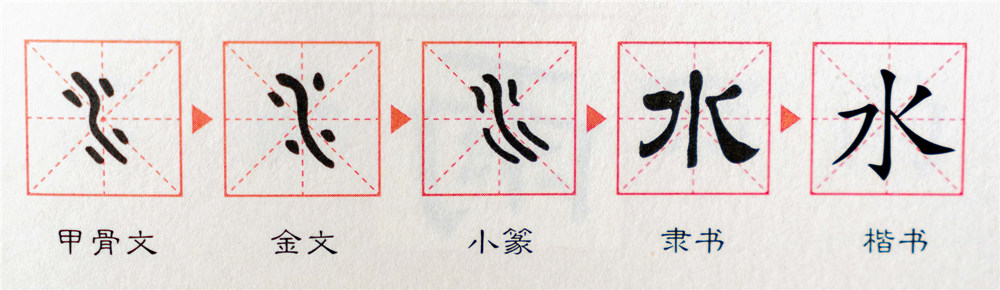
Ancient men didn’t get water from a tap. They
collected it from rivers and streams.
At a glance, 水 has absolutely no relation to the word water.
Whoever invented a character to represent
the word ‘water’ had to rely on imagery common at that time.
Depicted on the far left of the image above
is the earliest representation of a Chinese character for ‘water’. It’s a
pictograph of a river.
The middle line represents the deeper
middle section of a river. The edges represent the shallower areas where water
rushes over rocks or other obstacles, creating waves and white water.
Over time, these attributes have been
simplified. By comparing the origin of this Chinese character to the modern-day
version, 水 becomes a very meaningful symbol.
The deep, rushing core of the river and its
turbulent outer edges.
Pretty neat.
Etymology of Chinese character 泉
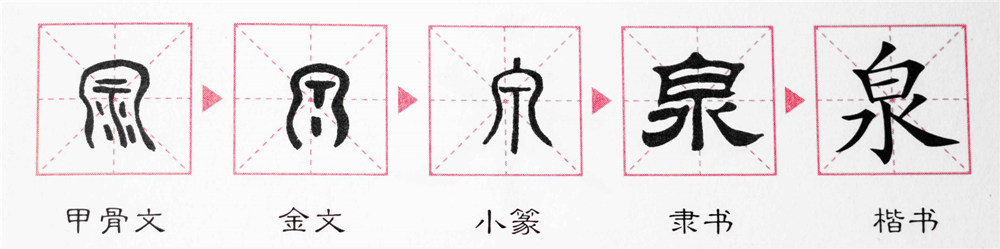
Let’s consider the character 泉 (quán) spring.
There are a few ways to deepen your
understanding of this character.
For example, we can break it into its
components:
白 (bái) white
水 (shuǐ) water
White water alone gives us a clue to the
combined meaning. After all, a spring in nature is a clean, pure (white) source
of water.
Let’s dive deeper.
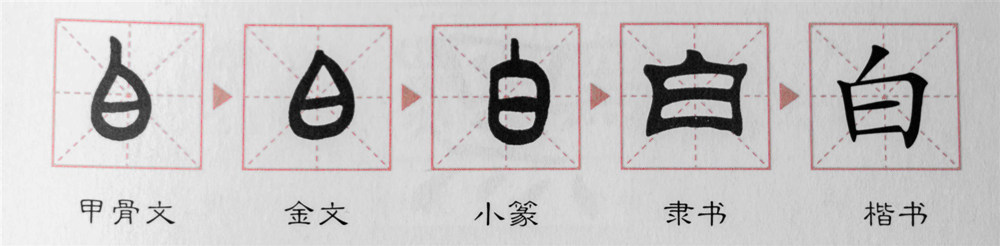
The history of the character 白 also gives us a clue to its meaning.
In the ancient 甲骨文
(jiǎ gǔ wén) oracle bone script, 白 is drawn as 日 (rì) sun with a drop on top.
Despite 3000+ years of meddling, it has
pretty much stayed like that.
Some think the ancient Chinese script
symbolises the time just before the sun peeps over the horizon when the area of
sky above the sun is briefly cast a brilliant white.
It could also represent the bright white
light cast at the entrance of a cave.
Either way, it’s clear that the sun here is
used to depict white light.
Our brains like patterns. They don’t like
randomness. We’re building stories and meaning (understandable patterns) into
these characters.
They are no longer squiggles on a page, or even a sequence of strokes. Chinese etymology helps build a stronger story for our minds.
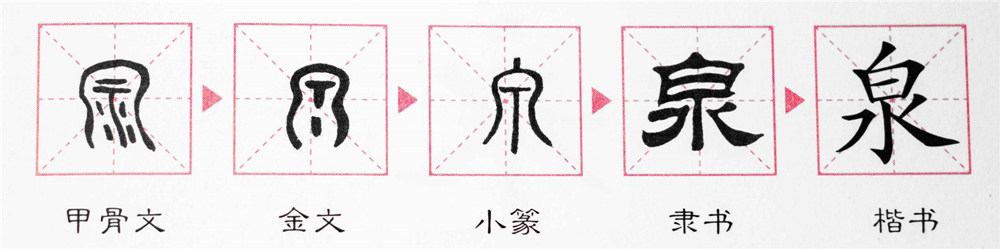
So we now know both components of 泉 (quán) spring. Cool.
How do they work together?
Well actually, they don’t.
I mentioned corruption earlier. This can be
seen in the history of the character 泉.
If we look at the oracle bone script here, 泉 is beautifully depicted as a river or stream (notice the same
oracle bone character as 水) running out of an opening
or cave in the ground.
This makes perfect sense.
A spring begins life as rainwater. Once fallen,
it finds its way underground, eventually reemerging from an underground
opening.
This opening is often seen from above as cracks between rocks, which water appears to rise (or spring) from.
So here you can see a cavern-like opening in which water flows out from a spring.
Understanding both the modern components (水 and 白) and their origins gives your brain multiple stories to work with, understand, and remember.
It also allows you to undo history and return 泉 to its original picture-like essence.
Using Chinese Etymology to Distinguish Similar Characters
Let’s quickly look at two more characters.
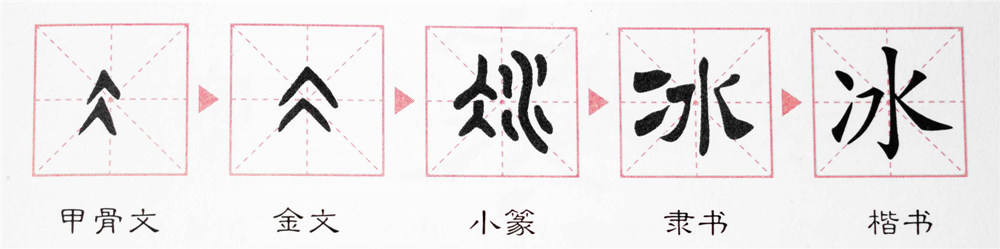
冰 (bīng) ice
This character is composed of two elements.
The 甲骨文 (jiǎ gǔ
wén) oracle bone script uses two arrow-like strokes representing cracks formed
in ice (think of ice in its natural form in nature).
The addition of a river, or water (水) was later used to indicate the relationship between ice and water.
If we apply this to the modern-day character, 冫is actually cracks within 水 water.
You could read it as ’cracked water’: ice.
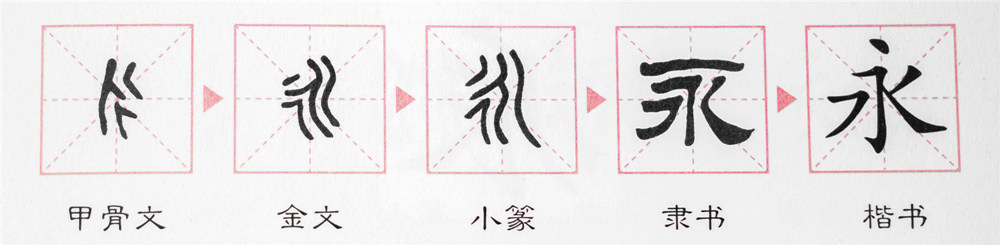
永 (yǒng) eternal/perpetual
Here the transformation over time has been
a trade-off between how easy the character is to understand and how easy it is
to write.
The ancient scripts depict two rivers
converging, ultimately joining to become a raging torrent.
Because of the merging of the two rivers,
the main river is able to flow out the other side continuously, uninterrupted.
This has connotations of something
stretching out into the future and simultaneously connected to the past.
The drop above 水 represents this: one continuous river, flowing eternally.
Seeing the Origin of Chinese Characters In Modern Day Script
水 泉 冰 永
水 is a river with a strong, deep core and
turbulent edges.
泉 is pure white water coming from the mouth
of an underground cavern.
冰 is the cracks in ice–frozen water.
永 is two rivers converging into one.
The more you know about the character 泉 (quán), the more likely you are to never forget it. By understanding the formation and evolution of Chinese characters, you can appreciate how they have been simplified from ancient pictographs to modern-day symbols. For example, the ancient scripts relied heavily on visual representations of words, much like Egyptian hieroglyphics. Over time, these characters were simplified, but their origins often hold the key to understanding their true meanings.

Leave a Reply
You must be logged in to post a comment.