Tones Prefer Company! Part II – An exciting new audio-visual way to practice Mandarin tones
Tones Prefer Company! Part II – An exciting new audio-visual way to practice Mandarin tones
My last Digmandarin article “Tones Prefer Company!“ generated a lot of interest, prompting me to pen this follow-up. The idea that tones should not be studied in isolation, and the limited usefulness of the classic “mā má mǎ mà” example, resonated with a lot of readers.
It was also through my article. We put together the very useful chart below, showing the 20 tone pairs in standard Mandarin, with a familiar example for each. The 20 comes from the fact that a 2-character word can begin with one of the four tones, and end in one of the four or the fifth neutral tone.
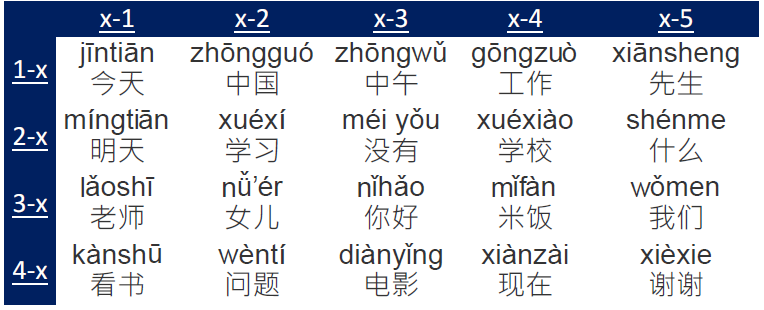
(For extra credit, note that 3-3 pairs are pronounced exactly the same as 2-3 pairs, so really there are only 19 unique Mandarin tone combinations – you can read more about why here.)
To review the concept – if a Chinese 2-character word begins with 1st tone and ends with 1st tone, we put it in the 1-1 tone pair bucket. All words in the 1-1 bucket have the same intonation, so if you know one well, you can apply that pronunciation to all other words in that bucket. It helps to pick one familiar word as the label for that bucket. So you may call 1-1 words the “today” bucket or the “airplane” bucket. Let’s give it a try.

| Pinyin | Translation | Simplified / Traditional | Audio |
| Jīntiān | today | 今天 |
|
| fēijī | airplane | 飞机/飛機 |
|
| yīshēng | Doctor | 医生/醫生 |
|
Let’s try another, the 1-2 tone pair, you may call this the “forest” or “China” bucket. Here, there is a distinctive jump from the 1st tone down to the start of the rising 2nd tone.

| Pinyin | Translation | Simplified / Traditional | Audio |
| sēnlín | forest | 森林 |
|
| gōngrén | worker | 工人 |
|
| ānquán | safety | 安全 |
|
| zhōngguó | China | 中国/中國 |
|
| bīnghé | glacier | 冰河 |
|
We covered the 3-2 tone pair in the last article, but it’s worth revisiting. It is a beautiful phonetic pattern, with the 3rd and 2nd tones blending together in a smooth curve. Notice that the 3rd tone is not falling and rising, as often described – it is a deep, throaty sound.

| Pinyin | Translation | Simplified / Traditional | Audio |
| cǎoméi | strawberry | 草莓 |
|
| nǚ’ér | daughter | 女儿/女兒 |
|
| měiguó | United States | 美国/美國 |
|
| yǎnyuán | actor | 演员/演員 |
|
| hǎitún | dolphin | 海豚 |
|
Now let’s have a look & listen at tone pairs that include the 4th, falling tone.

| Pinyin | Translation | Simplified / Traditional | Audio |
| gōngzuò | work | 工作 |
|
| gāodà | tall, lofty | 高大 |
|
| yīnyuè | music | 音樂 |
|

| Pinyin | Translation | Simplified / Traditional | Audio |
| niúròu | beef | 牛肉 |
|
| chéngkè | passenger | 乘客 |
|
| juéshì | Jazz | 爵士 |
|

| Pinyin | Translation | Simplified / Traditional | Audio |
| rùkǒu | entrance | 入口 |
|
| zìdiǎn | dictionary | 字典 |
|
| diànnǎo | computer | 电脑/電腦 |
|
Here again is a useful word list for illustrating tone combinations. Use it in addition to the “mā má mǎ mà” example, to not only impress your friends but give them a more realistic point of reference for understanding Chinese pronunciation.
| Pinyin | Tone Pair | Translation | Simplified / Traditional |
| zhǔjiǎo | 3-3
pronounced like 2-3 |
lead actor | 主角 |
| zhùjiào | 4-4 | assistant professor | 助教 |
| zhùjiǎo | 4–3 | footnote | 注脚/註腳 |
| zhūjiǎo | 1–3 | pork knuckle | 猪腳 |
And let’s close with another useful example, of two common words that sound alike except for the difference in tone pairs – also two of my favorite things after a long day of studying Mandarin:
| Pinyin | Tone Pair | Translation | Simplified / Traditional |
| shuǐjiǎo | 3-3
pronounced like 2–3 |
crescent-shaped boiled dumplings | 水饺/水餃 |
| shuìjiào | 4–4 | sleep | 睡觉/睡覺 |

Related reading resources:
Chinese pronunciation foundation: The Complete Chinese Pronunciation Guide
Experience sharing:
- From Frustration to Fluency: Master Chinese Pronunciation with 6 Techniques
- How to Get the Tones in Chinese Right, and then Fix Them in Your Head!
- How to Master Tones without Using Tone Marks
- Recommended Chinese Songs for Perfecting Your Accent
- How to Improve Your Mandarin Chinese Pronunciation
- Top Tools to Help You Learn Chinese Pronunciation and Pinyin

Leave a Reply
You must be logged in to post a comment.