Tones Prefer Company! – A New Way to Practice Chinese Tones
Tones Prefer Company! – A New Way to Practice Chinese Tones
When you hear someone discuss the basics of Mandarin pronunciation, they usually start with the four tones and give an example like the famous (mā má mǎ mà). To be fair, they might also mention the fifth, neutral tone.
Learning the basic tones is a good start, but it misses two important points:
1. Chinese is not simply a string of syllables – the meaning of the characters evolves when they are combined into words and phrases;
2. Similarly, the true rhythm of spoken Chinese emerges as the tones are combined with one another.
I realized early on in my Mandarin studies that it is helpful to learn to pronounce pairs of tones. All the words that use a particular tone combination have the same sound pattern. These sound patterns can be stacked together to form fluent phrases and sentences of any length.

3rd tone + 1st tone
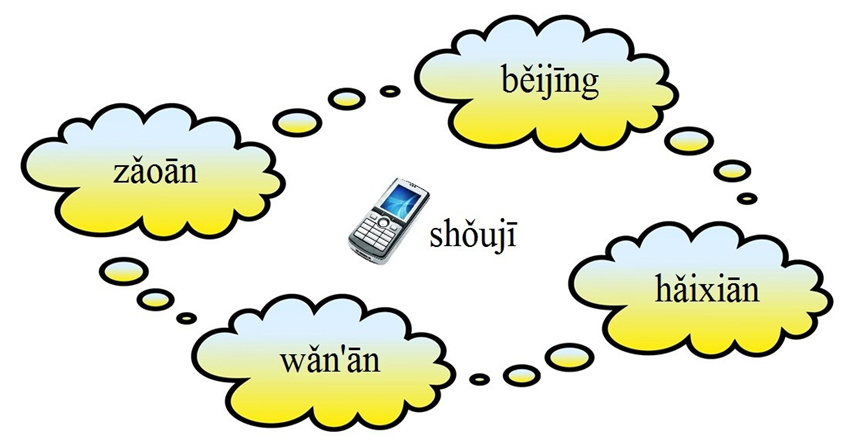
For example, to practice the 3-1 combination – a deep third tone followed by a high first tone – think of a commonly heard 3-1 word, such as ‘cell phone’ (手机,shǒujī). If you’re not sure you’re pronouncing it correctly, ask your teacher or a friend who is a native speaker to practice it with you. Now when you come across other 3-1 words, such as ‘Good Morning!’ (早安,zǎoān), ‘Good Night!’ (晚安,wǎn’ān), ‘Beijing’ (北京,Běijīng), ‘seafood’ (海鲜,hǎixiān), ‘seaside’ (海边,hǎibiān) … think back on the original word that you already know well, and pronounce these confidently with the same rhythm.
3rd tone + 2nd tone
Of course, you can use any word that is familiar and easy for you to remember, to associate with a particular tone pair. I personally refer to the 3-2 combo as the strawberry group. Notice how ‘strawberry’ (草莓,cǎoméi), ‘United States’ (美国,Měiguó), and ‘actor’ (演员,yǎnyuán) all have the same rhythm, a smooth wave that starts deep and rises at the end.
4th tone + 4th tone
Let’s try one more, the 4-4 combo, you might call this the ‘Goodbye!’ group: ‘Goodbye!’ (再见,zàijiàn), ‘consultant’ (顾问,gùwèn), ‘forget’ (忘记,wàngjì).
Next time someone asks you about the tones in Mandarin, instead of the old standby (mā má mǎ mà), why not give this slightly more complex – and more fun – example using tone combinations:
- (zhǔjiǎo) 3-3 means ‘主角, lead actor’
- (zhùjiào) 4-4 means ‘助教, teaching assistant’
- (zhùjiǎo) 4-3 means ‘注脚, footnote’
- (zhūjiǎo) 1-3 means ‘猪脚, pork knuckle’.
Next Reading:
Tones Prefer Company! Part II – An exciting new audio-visual way to practice Mandarin tones
Related reading resources:
Chinese pronunciation foundation: The Complete Chinese Pronunciation Guide
Experience sharing:
- From Frustration to Fluency: Master Chinese Pronunciation with 6 Techniques
- How to Get the Tones in Chinese Right, and then Fix Them in Your Head!
- How to Master Tones without Using Tone Marks
- Recommended Chinese Songs for Perfecting Your Accent
- How to Improve Your Mandarin Chinese Pronunciation
- Top Tools to Help You Learn Chinese Pronunciation and Pinyin

Leave a Reply
You must be logged in to post a comment.