Chinese characters, the building blocks of one of the world’s oldest and most complex writing systems, have fascinated scholars, students, and linguists for centuries. Understanding the number of Chinese characters and their usage can be a daunting task, but it becomes clearer when we categorize them by different levels of proficiency and use.
The Basics: An Introduction to Chinese Characters
Chinese characters, known as 汉字 (Hànzì), are logograms used in the writing of Chinese, Japanese, Korean, and other languages. Unlike alphabetic systems, each Chinese character represents a word or a meaningful part of a word. The number of Chinese characters is vast and continually evolving, influenced by historical, cultural, and social factors.
How Many Chinese Characters Are There in Total?
The exact number of Chinese characters is hard to pinpoint due to the language’s long history and continuous evolution. However, comprehensive dictionaries provide an estimate:
- Kangxi Dictionary (康熙字典): One of the most authoritative dictionaries, compiled in the 18th century, lists approximately 47,035 characters.
- Hanyu Da Zidian (汉语大字典): A more modern and comprehensive dictionary includes around 56,000 characters.
While these numbers are impressive, it’s important to note that many of these characters are archaic or rarely used.
Categories of Chinese Character Knowledge
1. Primary School Student
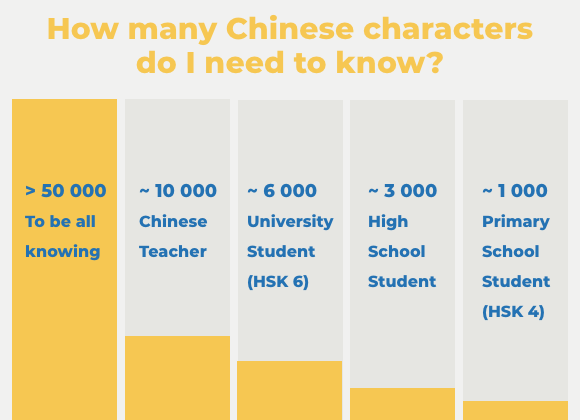
Primary school students in China typically learn the most commonly used characters. By the end of their primary education, they are expected to know around:
1,500 to 2,500 characters: This range covers the essential characters needed for basic reading and writing. These characters form the foundation of the language and are frequently used in everyday life.
2. High School Student
High school students build on their primary education, learning more complex characters and expanding their vocabulary:
3,000 to 4,000 characters: By the time they graduate, students should be comfortable with a broader range of characters, enabling them to read newspapers, novels, and academic texts.
3. University Student
University students, especially those majoring in Chinese language and literature, will further expand their knowledge:
5,000 to 7,000 characters: This level of proficiency allows students to engage with classical texts, academic research, and more sophisticated literature.
4. Chinese Teacher
Chinese language teachers, who need to guide students through the intricacies of the language, possess an even greater command: 7,000 to 10,000 characters: Teachers must understand a wide range of characters to explain nuances, idiomatic expressions, and classical references effectively.
5. Chinese Language Expert
Experts, such as lexicographers, linguists, and advanced scholars, delve into the depths of the language:
10,000+ characters: These individuals not only know an extensive number of characters but also understand their historical developments, variations, and usage across different contexts.
Practical Usage vs. Theoretical Total
While the theoretical total number of Chinese characters exceeds 50,000, practical usage requires far fewer. For daily life, work, and general reading, a solid grasp of around 3,000 to 4,000 characters is sufficient. This practical approach aligns with the concept of a core vocabulary used in most written and spoken communication.
So the answer as to how many Chinese characters there are
The number of Chinese characters one needs to know varies greatly depending on the individual’s goals and context. From the foundational 1,500 to 2,500 characters learned by primary school students to the extensive knowledge exceeding 10,000 characters held by language experts, the Chinese writing system offers a rich and complex tapestry for learners at every level. Whether you’re a student beginning your journey or a scholar deepening your expertise, understanding the scope and depth of Chinese characters is a rewarding and ongoing process. By recognizing these different levels of proficiency, learners can set realistic goals and appreciate the beauty and complexity of the Chinese language.

Leave a Reply
You must be logged in to post a comment.