Top 3 Tips for Taking Notes while Learning Chinese
Top 3 Tips for Taking Notes while Learning Chinese
Hello everyone! After revealing my “Tops Secret about learning Mandarin,” today I’m focusing on the details of your trusty companion—the notebook you write in and read every single day. In this article, you’ll learn how to effectively manage new vocabulary in your notebook!

In the notebook, I divide content into two zones. The first is the “Words Zone” and then the “Example Zone.” This not only helps you have a tidier notebook but also when you want to make a “Quick Review.” You can just read the only vocabulary list! So, let’s see how they work!

1. Words Zone
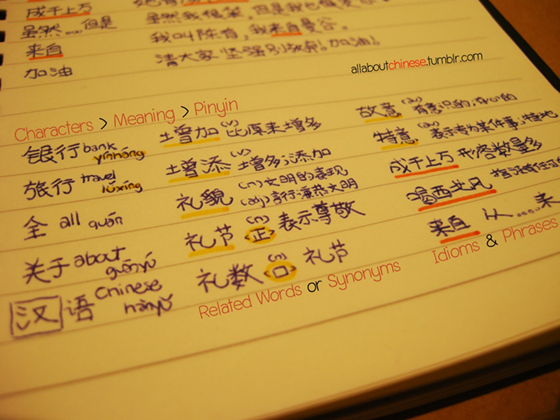
As its name implies, you will gather and collect your new words down here, and this is the way that you will organize them.
A. Character Section
Make sure that the new vocabulary that you’re going to take note of is correct. Quite easy, ha!
Related Post: A Comprehensive Guide to Chinese Characters
B. Pinyin Section
Kick pinyin to the curb! Make it small as much as possible, so you will not see them so easily. For me, I always put it behind the meaning, and this will help you to not rely on it. So you won’t see them!
Please check if the vocabulary is a multi-sound character. Some words when they are used as nouns, will be pronounced one way, but when used as adjectives, it will be in another way!
For example, “空”, if you mean “vacancy/space (n),” you have to say kòng, but if you mean “empty (adj.),” you have to say “kōng”!
Related Post: Chinese Pronunciation Guide
C. Meaning Section
What you have to decide is: does the word have related words or synonyms? If the answer is yes, there will be 4 points that you need to know more about, and yes, we have to note them down, for sure!
i. Is the vocabulary a specific word or an abstract word? Some words are only used for specific, and the related word will be used for specific. For example, 增加(zēng jiā) and 增添(zēng tiān); both mean “increase” but 增加 is used with countable things (specific), such as numbers, and 增添 is used with uncountable things (abstract), such as feelings.
ii. For some synonyms, you must know the occasion that it is used to. Is it able to be used on every occasion? Is it slang or spoken Mandarin? Official word? Literal, written, or classic word? Try to know and you will use it right! When I take notes, I will write the word that stands for these occasions, such as 正 (for 正式 official), 古 (for 古文 Classical), 口 (for 口语 Spoken), etc.
iii. For some words, we need to know what the meaning exactly place emphasis on, such as 故意(gù yì) and 特意(tè yì); you can see that it means deliberately, but 特意 emphasizes doing good things, while 故意 emphasizes doing bad things.
iv. Is it a noun, verb, adjective, or adverb? As every word doesn’t have a pattern that we can see like in English, you need to know how it is used. Some vocabularies can be used in many forms, but some cannot. Example: 礼貌 (lǐ mào) and 礼节 (lǐ jié), both mean “Courtesy (n.)” but only 礼貌 can be used as an adjective and mean “be polite.”
*Tips: Separate idioms and phrases from other short vocabulary, because they have long meanings and this will help you find them easier when you want to search them. For me, I put it in the last column of the vocabulary list.
2. Example Zone

This is the zone where you will write down the vocabulary, phrase, or sentence structure that you need some example of, so you can review and always understand!
A. Arranging
Bring the new vocabulary that you need some examples of to the front, and don’t forget to highlight them when you write in the sentence so you can find them easily.
B. Writing the example
The best example is the example that you create by yourself, but don’t forget to ask your teacher if it’s not weird; this will help you remember it better, and help you practice using the vocabulary.
* Tips: Don’t forget to highlight the words that you have examples of in the Words Zone. This will help you know whether you have examples for those words or not.
3. Top of the Tops Secret
Use less of your mother tongue in your notebook! Try to take notes in Mandarin as much as possible—that’s how we can make more progress and have more chances to use it. That’s exactly how I took notes when I was learning Mandarin.
However, no matter how good your notebook is, you have to review it; the more you review, the more valuable your notebook becomes. For more tips and resources, be sure to check out Chinese for Beginners. Thanks for reading, and I hope you can apply some of these strategies in your own notebook!

Leave a Reply
You must be logged in to post a comment.